
PET CARVING IDEAS
Dog pumpkin carving ideas that look like your dog
The dog pumpkins people remember are the ones that are obviously their dog: the one floppy ear, the white blaze, the goofy open-mouth grin. Pick an idea below that shows off what makes your dog recognizable, then use a pattern made from your own photo instead of a generic dog stencil.
Dog pumpkin ideas that actually look like your dog
- Face portrait. The most personal option and the hardest to get right freehand. A straight-on face that fills the flat side of the pumpkin reads best from the sidewalk. Use a pattern made from a close-up photo, not a full-body shot.
- Silhouette. A side-on outline of your dog sitting, begging, or mid-zoomie. Silhouettes are the easiest dog carving for beginners because you cut one big shape. They work when your dog's outline is distinctive: a dachshund's long body, a German shepherd's tall ears, a poodle's topknot. A generic "dog shape" won't say which dog it is.
- Paw prints. Four toe pads and a heel pad, cut or drilled. Paw prints are quick, safe for kids to help with, and look good trailing around the back of a portrait pumpkin or on a small second pumpkin beside it.
- Breed features. Exaggerate what your breed is known for: bat ears on a French bulldog, a husky's face mask, a golden's feathered ears. Our guide to carving your dog's breed covers how different ears, snouts, and coats show up in pumpkin light.
- Dog plus name. Put the name under the portrait or on a second pumpkin. Letters with enclosed holes (A, B, D, O, P, R) will drop their centers unless you leave a small bridge, so use a stencil-style font or etch the letters instead of cutting through.
- Dog in costume. Carve the costume your dog is actually wearing this year: a witch hat, a hot dog bun, devil horns. Keep the costume shapes big and simple so the face still reads. Hats and horns sit outside the head outline, which makes them easy to cut and easy to see.
- A matching pair. Carve your dog on one pumpkin and a family member on another, or two dogs side by side. Two medium pumpkins are easier to carve well than one crowded large one.
- A memorial pumpkin. A portrait of a dog who has died can be a gentle way to include them in the season. Choose a favorite photo where their face is clear, and consider etching instead of cutting so it lasts a little longer.
Carving with children? Paw prints, a bone, and a simple silhouette are good starter projects. Kids can push out cut pieces, and from about age 9 they can poke the pattern dots, while an adult handles the saw. See safe jobs for every age.
Make it read when lit
What glows is what you cut. In the dark, the holes are the bright parts and the pumpkin wall is dark. Plan the design for how it will look lit, because that is how most people will see it.
This is where most dog portraits go wrong. Photo-carving tutorials often tell you to cut out the darkest parts of the photo. That looks right in daylight, when holes look dark, but at night the whole face flips into a photographic negative: the black nose and eyes glow and the light fur goes dark. People find faces in negative surprisingly hard to recognize, which is a well-studied effect in vision research.
For a portrait that looks like your dog after dark, cut the light parts of the photo and keep the dark parts as solid pumpkin:
- Eyes and nose stay mostly uncut, with a small cut highlight in each eye if you want them to sparkle. That tiny glint does a lot of the work of making a portrait look alive.
- Light fur becomes the glowing area, broken into pieces by the darker fur lines and shadows you keep.
- A dark-coated dog ends up with little cut inside the face. Cut the background around the head instead so the outline of the ears and muzzle glows, then add the few highlights: eye glints, the shine on the nose, any white markings.
- A very pale dog ends up mostly cut, which leaves a fragile face. Keep the shadow lines around the eyes, muzzle, and ears thick enough to hold the design together.
Every piece you keep must connect back to the rest of the pumpkin. A pupil floating inside a cut-out eye has nothing to hold it and will fall out. Either leave a small bridge, or etch the area (scrape off the skin without cutting through) so it glows softly instead.
Size matters too. Fine fur and whisker lines that look clear on paper can be too thin to saw at 7 in (18 cm). Give a portrait the largest flat side you have, and choose a pumpkin with at least an inch (2 to 3 cm) of spare surface around the pattern. The printing and sizing guide explains how to measure.
How to get a pattern of your dog
You have three realistic options. Each suits a different amount of time and budget.
- A free breed stencil. Many sites offer free stencils for popular breeds. They are free and ready now, but they show a typical dog of that breed, not yours. They work well for silhouettes, paw prints, and bones.
- Make your own from a photo. Convert the photo to grayscale, raise the contrast, and reduce it to two or three tones in a free editor such as GIMP (Colors, then Posterize). Print it, decide which tone you will cut, and draw bridges wherever a kept piece floats. It is free and fully yours, but plan on an hour or more at the computer, and you have to check the connections and thin spots yourself.
- Have one made from your photo. CarveKin uses an AI image model to draw a carving design from your photo, drawn the way it will look lit, then repairs and checks the pattern at your print size so every kept piece connects and no cut is too narrow to saw. You see a first look before you pay, pick from a few designs, and print a PDF at actual size. One pattern is $4.99; the Family pack is five for $9.99. If none of the designs look like your dog, you can try again without using your credit or ask for a refund.
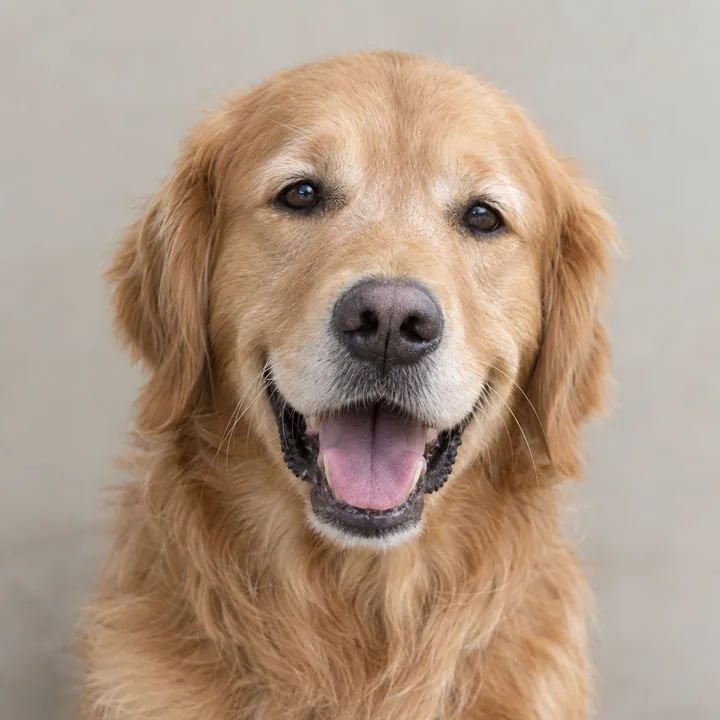
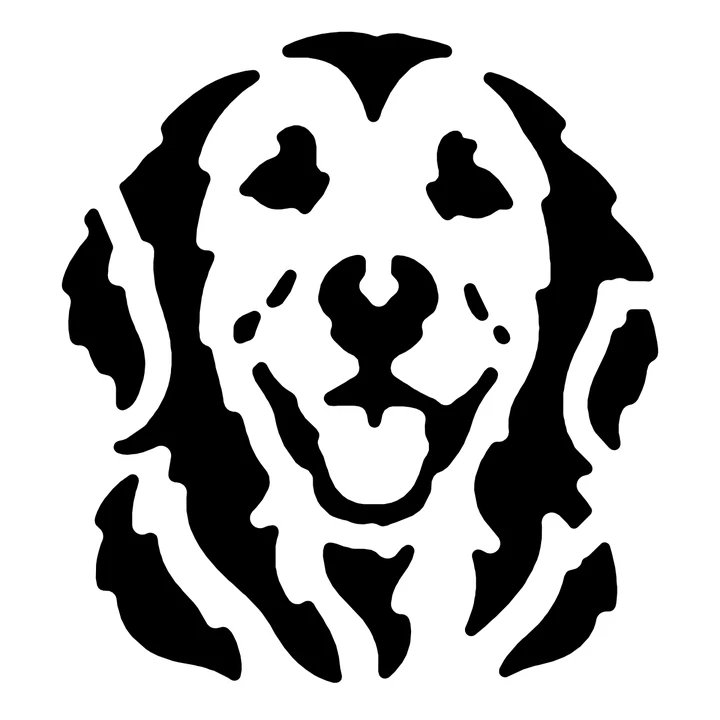
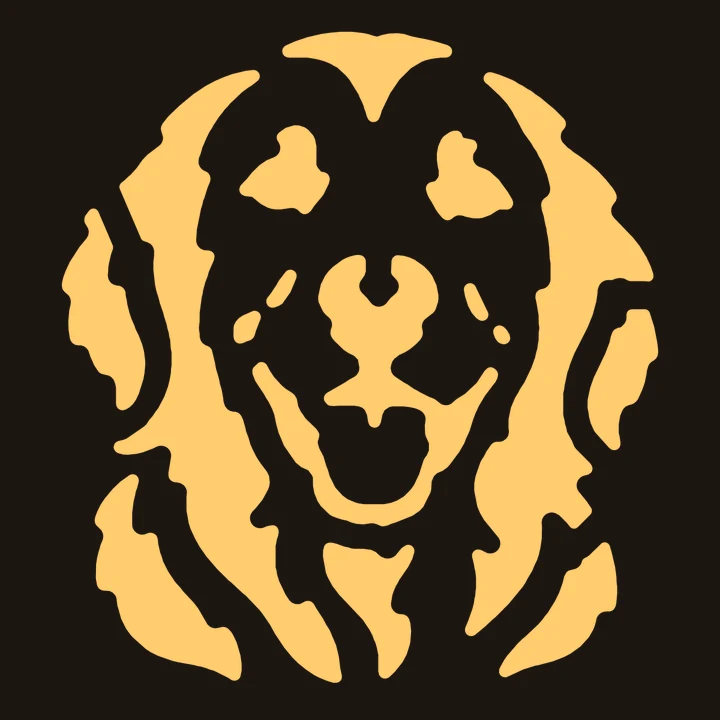
See this golden retriever at Easy, Standard, and Challenging detail levels.
Pick the photo
The photo decides more than the carving does. The short version:
- Face toward the camera, eyes open, ears in their usual position.
- Close enough that the head fills most of a square crop.
- Soft daylight, such as near a window. Flash flattens fur and harsh sun makes hard shadows that turn into odd cut shapes.
- A plain background, with no hands, leashes, or toys crossing the face.
For more detail, read making a pattern from your pet's photo and how to choose a photo for a pumpkin pattern. When you have a pattern, follow the step-by-step carving guide.
Keep your dog safe around pumpkins
Pumpkins themselves are not the danger. The ASPCA describes them as relatively non-toxic, though nibbling can upset a pet's stomach. The risks come from flames, the leftovers, and a pumpkin left out too long.
- Use a battery light. The ASPCA warns that pets can easily knock over a lit jack-o'-lantern and start a fire. A wagging tail at porch height is exactly the wrong place for a candle. Fire safety guidance from the NFPA also says a flashlight or battery-operated candle is the safest choice.
- Keep the batteries away from chewers. Pet Poison Helpline notes that chewed alkaline batteries can cause corrosive injuries, and swallowed disc or button batteries can burn the esophagus or intestines. Put the light where your dog can't get at it, and pick up any tea light that falls out.
- Clean up the guts and seeds. A veterinary gastroenterologist at Texas A&M notes that the seeds and fibrous strands are very high in fiber and eating too much can cause stomach upset. Keep the stem and other hard parts out of reach too.
- Throw it out when it goes soft. The Oregon Veterinary Medical Association warns never to let pets eat a leftover jack-o'-lantern, because a rotted, moldy pumpkin can make them seriously ill. Texas A&M advises throwing old pumpkins away once they become soft, discolored, or smelly. Don't toss it on an open compost pile your dog can reach.
- Know the signs of mold poisoning. Pet Poison Helpline lists vomiting, agitation, incoordination, tremors, seizures, and high body temperature as signs a dog has eaten moldy food, and says symptoms can start quickly. If you think your dog ate a moldy pumpkin, call your veterinarian right away. Pet Poison Helpline is at (855) 764-7661 and the ASPCA Animal Poison Control Center is at (888) 426-4435; the ASPCA charges a consultation fee.
If you want a pumpkin your dog can safely eat, use plain cooked pumpkin from the kitchen, not the one on the porch. Ask your vet how much suits your dog.
Make a pattern from your dog's photo
Sources
- ASPCA, Halloween safety tips
- ASPCA, Top 5 tips for a safe Howl-o-ween
- ASPCA, 5 toxic seasonal plants you don't want your pet to fall for
- Texas A&M Today, Pumpkin safety for a pet-friendly Halloween
- Oregon Veterinary Medical Association, Halloween safety tips for pet owners
- Pet Poison Helpline, Mold and dogs and Batteries
- Connecticut Commission on Fire Prevention and Control, NFPA Halloween fire safety tips
- Vuong and others, The role of surface pigmentation for recognition revealed by contrast reversal in faces, Vision Research (2005)
- GIMP documentation, Posterize